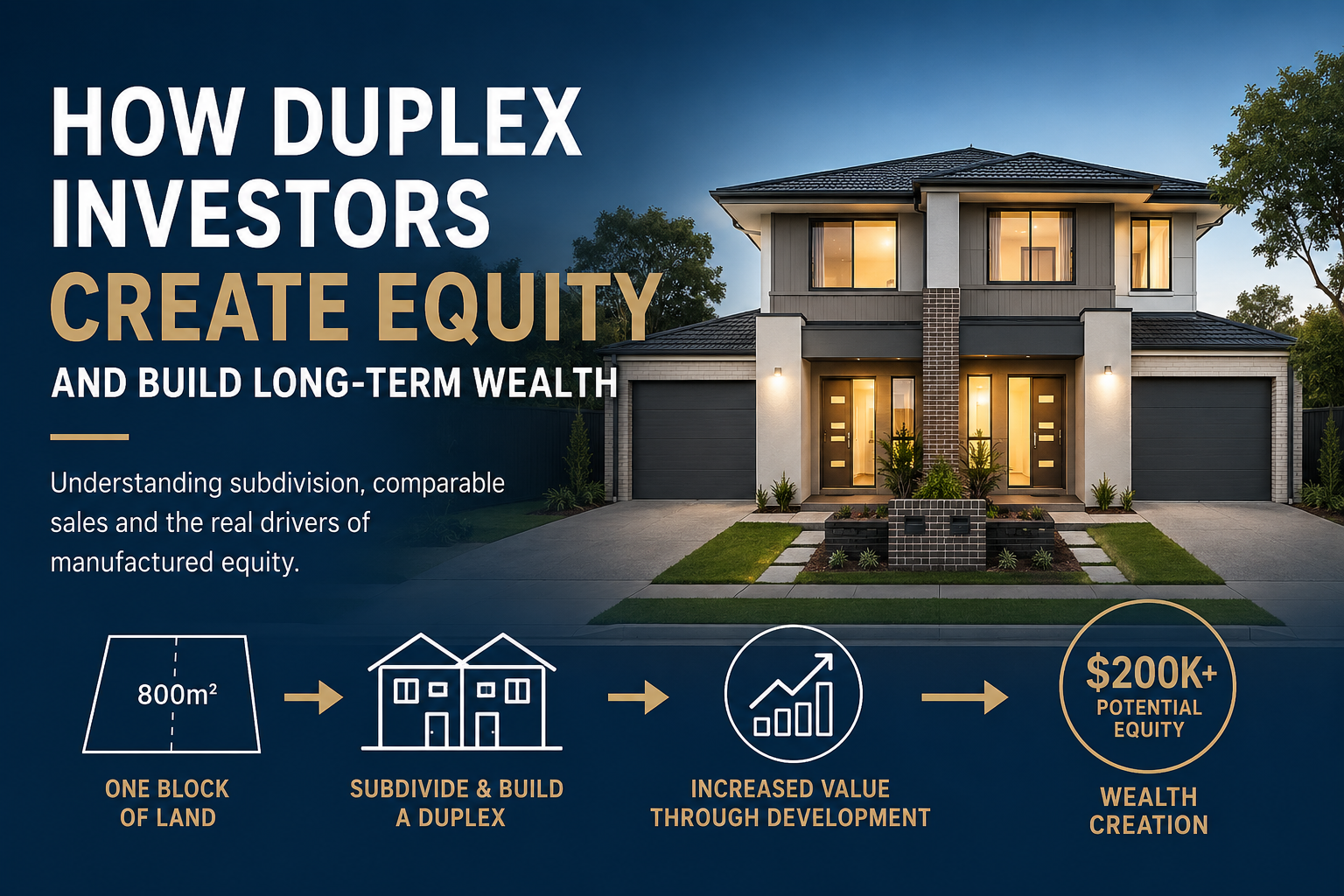
One of the biggest reasons investors are attracted to duplex developments is the potential to create equity during the construction process.
If you have spent any time researching duplex investments, you have probably seen claims of investors creating $100,000, $200,000 or even $300,000 or more in equity by building a duplex instead of buying a standard investment property.
So how is this equity actually created?
The answer lies in a combination of subdivision, more efficient use of the land, strong comparable sales and market growth during construction.
What Is Manufactured Equity?
Manufactured equity is simply equity created through the development process rather than through market growth alone.
Take a straightforward example. An investor buys a duplex site and completes the project for a total cost of $1.5 million. On completion, the two dwellings are independently valued at a combined $1.7 million. In that scenario the investor has potentially created $200,000 in equity.
Illustrative figures only. Cost split and end value vary by site, build and market. Always confirm with current comparable sales.
That equity may come from several sources at once:
- Subdivision into two separate titles.
- More efficient use of the land.
- Strong comparable sales supporting the completed value.
- Market growth during construction.
- Increased owner-occupier appeal.
Unlike waiting years for capital growth, manufactured equity is created through the development process itself. But it is not automatic. The numbers still need to stack up.
Why Duplexes Often Create Equity
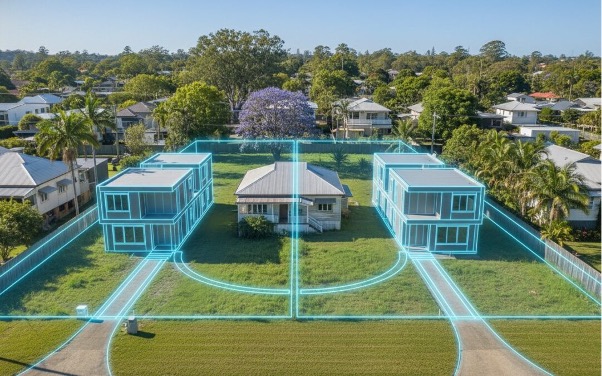
A duplex starts as a single parcel of land. Once construction and subdivision are complete, the investor typically owns two separately titled homes.
In many locations, two individual homes can be worth more than the combined land and construction costs required to create them. That is one of the reasons duplexes have become popular with investors looking to accelerate portfolio growth. However, not every duplex creates equity, and the site selection is what makes the difference.
More Efficient Use of the Land
Part of the value comes from creating two dwellings from a single land purchase.
In many markets, a 650m² block suitable for a duplex costs substantially less than buying two separate 325m² blocks and building two separate homes. You may not even be able to find 325m² lots, and finding two side by side to allow an efficient single build is very unlikely. A duplex lot creates efficiency through minimum lot size and a single build price.
One 650m² duplex block
- Single land purchase, single settlement
- One build, one contract, one program
- Shared site works and services
- Two saleable homes on completion
Two separate 325m² blocks
- Rarely available, and rarely side by side
- Two purchases, two sets of costs
- Two separate builds to coordinate
- Higher cost to reach the same two homes
By creating two homes from one land purchase, investors may unlock value that would not exist if the land stayed as a single dwelling.
Why Some Duplexes Create More Equity Than Others
The amount of equity created is heavily influenced by the value of each completed dwelling. Before committing, investors should examine recent comparable sales for similar duplex halves nearby.
These sales help establish what each completed dwelling may realistically be worth. If comparable four-bedroom duplex halves are consistently selling for around $850,000 each, the completed duplex may have a combined value of around $1.7 million. If the total package price is $1.5 million, that suggests a potential uplift of around $200,000.
By contrast, if comparable sales only support values of $750,000 per dwelling, the same $1.5 million project may create little or no equity at completion. This is why strong comparable sales matter so much, and it is what determines whether you can refinance your duplex to use the increased equity.
The projected end value should never be based on a developer's estimate alone. It should be supported by recent sales of genuinely comparable completed properties.
What If There Are No Comparable Duplex Sales?
In some markets, particularly newer estates or regional locations, there may be very few recent duplex sales. This does not necessarily mean a valuation cannot support the project.
Where direct duplex comparables are limited, valuers will often look at other comparable residential properties, including three and four bedroom houses, smaller lot housing, cottage lots, terrace homes and other attached or semi-attached dwellings.
The valuer's objective is to work out what a typical buyer would pay for a property with similar accommodation, appeal and functionality. For example, a completed duplex half offering four bedrooms, two bathrooms, a double garage and modern finishes may be compared against four-bedroom houses on smaller lots if those are the closest available sales evidence. This is common in newer growth corridors where compact-lot housing is more prevalent than established duplexes.
Direct duplex sales generally provide the strongest evidence, but they are not the only evidence a valuer can rely on. The key question is whether there is sufficient market evidence to support the value of the completed dwelling.
Comparable Sales Can Be Checked Before You Buy
One advantage of duplex investing is that the likely end value can often be investigated before you commit. A proper assessment should consider recent settled sales, current competing listings, property size and layout, bedrooms and bathrooms, garage configuration, street appeal, location within the suburb and owner-occupier demand.
The strongest evidence usually comes from recent settled sales of comparable duplex halves rather than general house sales or broad suburb medians. This does not guarantee the final valuation. Markets move, valuations vary, and the completed product may differ from the comparables. But checking comparable sales before purchase is a far more reliable basis for assessing potential equity than relying on broad claims about manufactured equity.
Agent Appraisals vs Property Valuations
Investors should also understand the difference between an agent appraisal and a formal property valuation. Some duplex projects are marketed with projected equity gains based on a local agent's opinion of what the completed dwellings may be worth after construction and subdivision.
Local agents can provide useful market insight, but an appraisal is still an opinion of what a property may sell for in the future. And with a duplex, the property has not been built yet, the subdivision has not happened yet, and market conditions may be different by the time the project is finished. As a result, projected values based purely on an agent's appraisal can prove overly optimistic.
Agent appraisal
- An opinion of a likely future sale price
- Often looks ahead 12 months or more
- Can be influenced by a sales motive
- Useful context, not lending evidence
Formal valuation
- Prepared by a registered valuer
- Based on recent comparable sales
- Reflects value at the time it is done
- What the bank actually lends against
A valuation is also an opinion, and different valuers can reach different conclusions. But it is built on current market evidence, not a hoped-for future figure.
When assessing a duplex opportunity, focus on the quality of the comparable sales supporting the projected end value rather than relying solely on future price estimates.
Market Growth Can Also Create Equity
Another factor is market growth during the construction period. Many duplex projects take between 12 and 18 months from land purchase to completion, or longer if the land is not yet registered at the time of purchase. If the local market grows during that period, the value of the completed dwellings may increase further. This is why some duplex projects achieve results above initial expectations.
Why Past Duplex Results May Not Be Achievable Today
Be careful when reviewing case studies and marketing material that highlight large equity outcomes. Many of the strongest duplex results seen over the past decade were achieved on projects purchased several years earlier, when land prices, construction costs, interest rates and infrastructure charges were all lower, and markets were growing strongly.
A duplex completed today may be compared against a project purchased two or three years ago under very different conditions. This does not mean duplexes no longer work. It simply means opportunities should be assessed on today's numbers, not yesterday's success stories.
The most important question is not "how much equity did someone make on a duplex bought three years ago?" It is "what do the comparable sales, construction costs and market conditions support today?" Every opportunity should be assessed on its own merits using current evidence.
What Is a Realistic Equity Outcome?
Many investors focus on the biggest success stories. Large outcomes do occur, but they should not be considered typical. In our experience, investors should look for projects where the potential uplift is roughly 10% to 20% of the total project cost.
The exact result depends on market conditions, comparable sales and the specific project. Be cautious of projections that rely on unusually optimistic assumptions.
What Can Go Wrong
Manufactured equity is only part of the story, and a duplex is not automatically a good investment just because it promises a large equity gain. Building in the wrong market can see overly optimistic growth reverse and erase any gains within two to three years.
There is little point creating $200,000 of equity if the property sits in an area with weak rental demand, oversupply, limited owner-occupier appeal or poor long-term growth prospects. The quality of the location still matters, and the completion valuation can also come in below expectations before the titles are split. Assess the downside as carefully as the upside.
The Biggest Mistake Investors Make
One of the biggest mistakes is focusing entirely on the equity created at completion, based on one agent's appraisal, and forgetting that the real wealth is often built over the following 10 to 20 years.
A duplex that creates $150,000 of equity and grows strongly over the next decade may ultimately outperform a duplex that creates $300,000 upfront but sits in a weaker market.
The Best Duplex Investments Combine Both
The strongest duplex opportunities typically bring several things together:
- Equity creation through subdivision.
- More efficient use of the land.
- Strong comparable sales.
- Market growth during construction.
- Strong rental demand.
- Long-term capital growth potential.
- Multiple exit strategies.
Manufactured equity may give you a head start, but long-term ownership of a quality asset is what ultimately builds wealth.
A Quick Note on Tax and Depreciation
A new duplex usually offers strong depreciation deductions on the building and fixtures, which can improve your after-tax position, and a quantity surveyor's report helps you claim the maximum. If you use a "sell one, keep one" strategy, selling a dwelling can also have capital gains tax implications. Tax outcomes depend on your personal situation and intent, so speak with your accountant rather than guessing.
Final Thoughts
Manufactured equity is one of the reasons duplex investing has become increasingly popular across Australia. But the best investors understand that equity creation is not luck. It is usually the result of buying the right site, making efficient use of the land, understanding comparable sales, managing construction costs, selecting strong growth locations, and allowing time for both equity and growth to work together.
The goal should not simply be to maximise manufactured equity. It should be to own a quality asset that combines equity creation, rental income and long-term growth. Because while manufactured equity gives you a head start, long-term ownership of quality assets is what ultimately builds wealth.
Read our free ebook on Duplex Investing in Australia →
Frequently Asked Questions
What is manufactured equity in a duplex?
Manufactured equity is equity created through the development process rather than market growth alone. When a single block is built on and subdivided into two separately titled homes, the combined value of the two dwellings can exceed the total cost of the land, construction and subdivision. That difference is the manufactured equity.
How much equity can a duplex create?
A realistic target is around 10% to 20% of the total project cost. On a $1.5 million duplex that is roughly $150,000 at 10% based on today's comparable sales, up to about $300,000 at 20% with reasonable market growth over 12 to 18 months. Large outcomes happen but should not be treated as typical.
What is the difference between an agent appraisal and a formal valuation?
An agent appraisal is an opinion of what a property may sell for, often in the future. A formal valuation is prepared by a registered valuer using recent comparable sales and current market conditions, and it reflects market value at the time the valuation is done, not a hoped-for future figure.
What if there are no comparable duplex sales in the area?
Where direct duplex comparables are limited, a valuer will look at other similar residential properties such as three and four bedroom houses on smaller lots, cottage lots, terraces or other attached dwellings, to work out what a typical buyer would pay for a home with similar accommodation and appeal.
If you liked this article, please feel free to share it on socials. If you like our content then subscribe via our website for more education. :)